
General Information
The KIPasti module is the third to be integrated into the KIParla corpus and comprises 63 table conversations collected in 13 Italian regions, totaling over 40 hours of recording and 482,892 tokens.
Overall, 145 speakers are involved, exhibiting diverse geographical characteristics and social backgrounds.
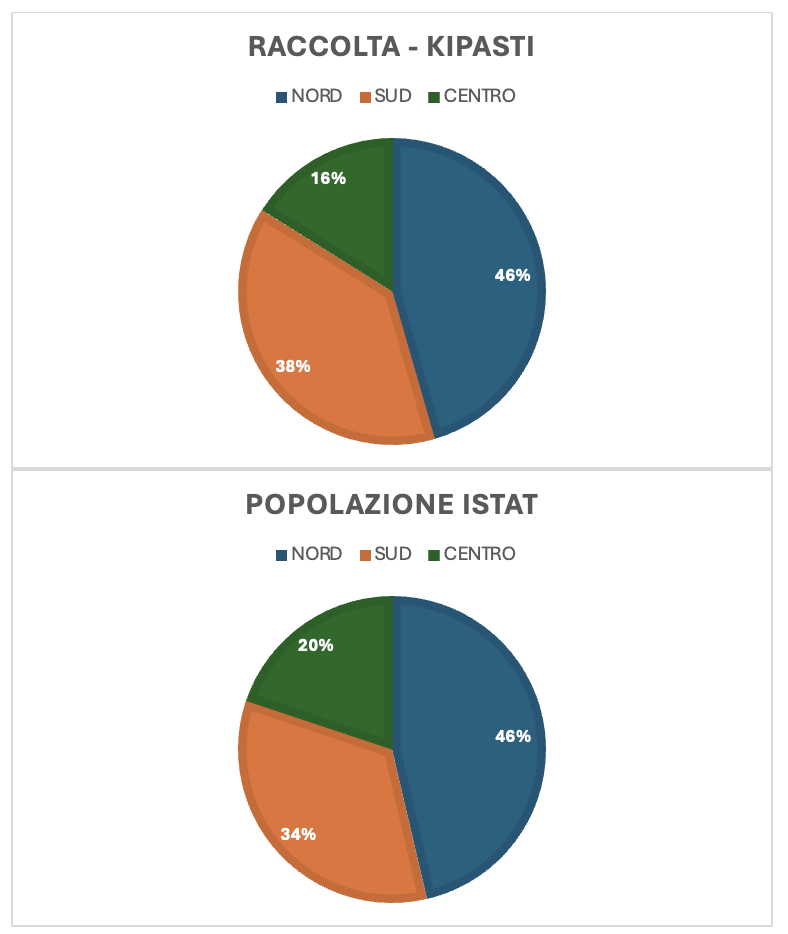
The corpus structure aims to represent the population of the northern, central, and southern macro-areas (with a maximum deviation of 4% from ISTAT data). More precisely, the recording hours are divided as follows:
- Northern: 19:25:31
- Central: 6:50:19
- Southern and Islands: 16:33:29
- TOTAL: 42:49:19
Among the collected data, several dialect inserts are present (in 78% of conversations). By consulting the transcription, a # can be found on the first word of the transcription unit where at least one dialect word is present.
Metadata
The module can be queried using the following metadata as search filters.
Conversations:
Number of participants:
- 2
- 3
- 4
- 5
Collection year:
- 2020
- 2021
- 2022
- 2023
- 2024
Province of collection:
- AN
- AR
- BO
- BR
- CA
- CE
- CZ
- FC
- FG
- LE
- LU
- MI
- MT
- PE
- PG
- RE
- RM
- RN
- TV
- VE
Languages of conversation:
- Italian
- Italian-dialect
Region of collection:
- Abruzzo
- Basilicata
- Calabria
- Campania
- Emilia-Romagna
- Lazio
- Lombardy
- Marche
- Apulia
- Sardinia
- Tuscany
- Umbria
- Veneto
Geographical Collection Area:
- Central
- Northern
- Southern
Speakers:
Occupation:
- N/A (i.e., data not available)
- Artisan
- Merchant
- Unemployed
- Occupations
- Intellectual
- Non-qualified
- Pensioner
- Student
- Technical
- Office
We adopted the classification of professions developed by Istat (to whose website we refer for more detailed information), integrating it with the categories pens for retirees, disocc for unemployed individuals, and stud for students.
Gender:
- Female
- Male
Region of origin:
- Abruzzo
- Basilicata
- Calabria
- Campania
- Emilia-Romagna
- Foreign
- Friuli Venezia Giulia
- Lazio
- Marche
- Piedmont
- Apulia
- Sardinia
- Sicily
- Tuscany
- Umbria
- Veneto
Age:
- 16-20
- 21-25
- 26-30
- 31-35
- 46-50
- 51-55
- 56-60
- 61-65
- 71-75
- 76-80
- 81-85
- Over85
Educational qualification:
- N/A (i.e., data not available)
- Elementary
- General Diploma Holder
- Professional Diploma Holder
- Technical Diploma Holder
- Degree in progress
- Degree
- Middle School
- PhD
Native language:
- Other
- Dialect
- Italian
- Italian-Dialectal
How to cite the module
Caterina Mauri, Silvia Ballarè, and Eleonora Zucchini. 2024. KIPasti Module, DOI: https://doi.org/10.60760/unibo/kipasti.
Coordinators
Caterina Mauri, Silvia Ballarè and Eleonora Zucchini
Contributors
The following individuals collaborated in data collection and transcription: Chiara Acetino, Lorenzo Albanesi, Eliana Andrisani, Martina Bastianelli, Giovanni Bocconi, Margherita Bologna, Elena Bregoli, Elena Breviglieri, Anna Camattari, Irene Campioni, Simone Cioffo, Giulia Frigione, Giorgia Lini, Omar Lorenzet, Elisabetta Manassero, Giulia Massaggia, Francesco Massidda, Filippo Mulinacci, Agnese Nania, Ilaria Nardelli, Alessia Palaia, Sara Perricone, Lucia Poma, Lara Ponticello, Francesca Righetti, Roberto Russo, Lucrezia Sabia, Alessia Sidoli, Patrizia Speranza, Nicola Tedesco, Olga Timcu.
Fundings
Project funded by the European Union – NextGenerationEU under the National Recovery and Resilience Plan (NRRP) – Mission 4 Education and Research.
Project 'DiverSIta – Diversity in spoken Italian', PI: Caterina Mauri. MUR Project Code [P2022RFR8T] – CUP [J53D23017320001]

Year of publication
2024